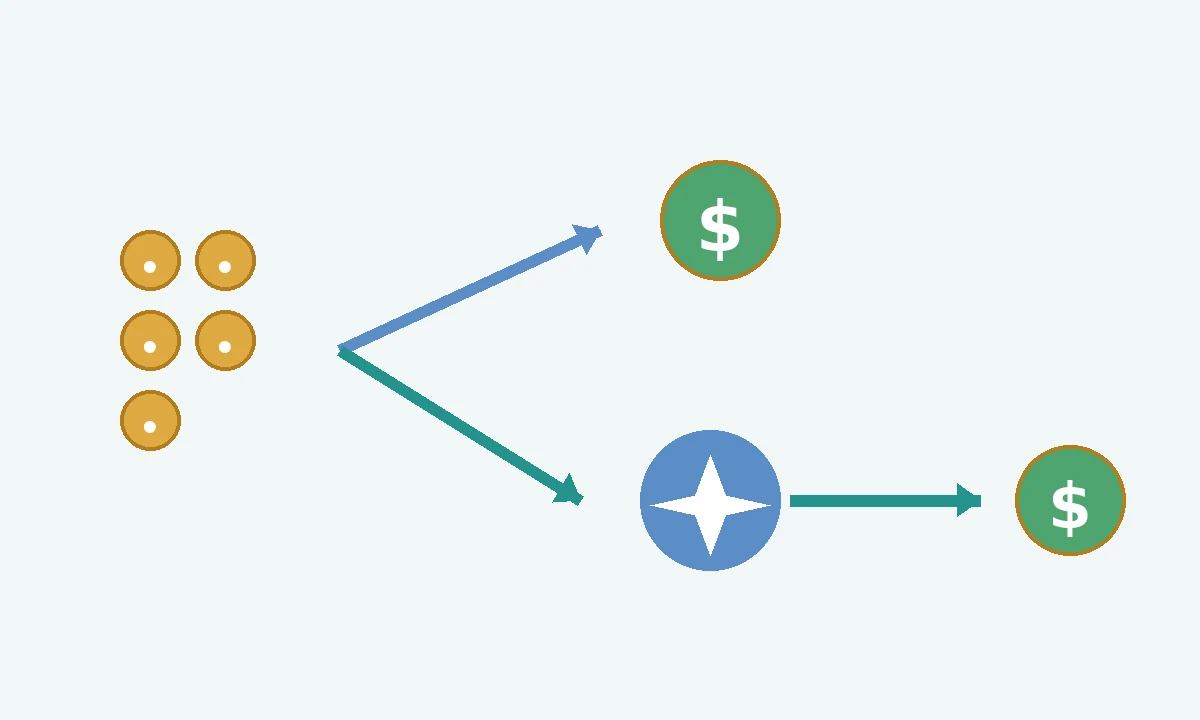
Should you transfer points or redeem them directly?
Learn when transferring credit-card points to Aeroplan or another loyalty program can be worthwhile and when keeping or redeeming them directly may be better.

In this guide
- Why transferable points are attractive
- The question to ask before every transfer
- Example: transfer to Aeroplan
- Do not transfer before checking availability
- The transfer ratio is not enough
- Destination programs add their own risks
- Availability can disappear during the process
- Think about insurance too
- When transferring often makes sense
- When it may be better to keep points flexible
- Transfer bonuses: always a good deal?
- How Carte IQ could model this
- A useful rule: require a margin of safety
- Can I reverse a Membership Rewards transfer?
- Should I transfer MR points to Aeroplan as soon as I earn them?
- Is a 1:1 transfer ratio always better?
- Does a transfer bonus justify a speculative transfer?
- What calculation should I use?
- Key takeaway
- Official sources consulted
- Suggested internal links
- Carte IQ CTA
Transferable points programs offer an attractive possibility: convert credit-card points into airline or hotel loyalty points.
On paper, this can look like an obvious way to increase value.
In practice, a transfer is only worthwhile when the reward you receive afterward is genuinely worth more than the option you are giving up.
Why transferable points are attractive
Consider American Express Membership Rewards.
Points can be used directly in several ways. American Express currently displays a value of 1,000 points for $10 through certain eligible credit options.
But MR points can also be transferred to partners such as Aeroplan, British Airways Executive Club, Air France KLM Flying Blue, Marriott Bonvoy and other eligible programs.
That creates optionality.
As long as the points remain in the original flexible program, you can decide later how to use them.
The question to ask before every transfer
Before transferring, calculate the direct-use value.
If 50,000 points can be redeemed directly for $500, then $500 is your opportunity cost.
A transfer is truly superior only if the reward you receive is worth more than that to you after taxes, fees and restrictions.
Example: transfer to Aeroplan
Suppose:
- 50,000 MR points;
- direct-use value of about $500;
- 1:1 transfer to Aeroplan;
- a flight is available for 50,000 Aeroplan points + $90;
- a comparable cash ticket costs $900.
Approximate net value replaced by the points:
$900 − $90 = $810.
In that scenario, transferring could produce more value than the $500 available directly.
But if the same ticket sells for $480, the conclusion changes completely.
Do not transfer before checking availability
American Express Canada is clear: transfers to partner programs are final.
Once the points are transferred, they cannot be moved back into Membership Rewards.
Amex recommends confirming reward availability with the third-party program before making the transfer.
This is probably the most important rule in any transfer strategy.
Find first. Transfer second.
The transfer ratio is not enough
A 1:1 ratio looks better than a 1:0.75 ratio.
But real value depends on what the points are worth after the transfer.
Example:
- 1,000 MR → 1,000 points in Program A;
- 1,000 MR → 750 points in Program B.
If each point in Program B produces much more value for the reward you want, the second transfer can still be better.
Calculate:
points received × value actually realized per destination-program point.
Destination programs add their own risks
Once transferred, the points are governed by the destination program.
That can involve:
- expiration or inactivity rules;
- reward-chart changes;
- limited availability;
- fees;
- partner changes;
- changes in value.
Keeping points in a flexible program avoids committing too early to one set of rules.
Availability can disappear during the process
Even when a transfer is fast, the reward you want may disappear before you book.
American Express currently indicates that transfers to Aeroplan and Delta SkyMiles may be instant when a valid partner account is already registered, while some other transfers can take several business days.
Knowing transfer times matters before moving points.
Think about insurance too
A booking made with points transferred to a third-party program is not necessarily treated the same way as a purchase charged directly to your card.
American Express notes that certain travel-insurance benefits may not cover third-party loyalty-program redemptions in the same way.
Check your card’s insurance certificate, particularly for coverage that depends on how the ticket was paid.
A high cents-per-point value is less useful if it causes you to lose protection you needed.
When transferring often makes sense
A transfer can be attractive when:
- you have found a specific reward;
- availability is confirmed;
- net value is clearly higher than the best direct use;
- you are ready to book;
- you understand taxes and fees;
- you accept the destination program’s rules.
When it may be better to keep points flexible
Wait when:
- you have no specific trip;
- you are transferring only because someone online says a program is “better”;
- you have not checked availability;
- the value difference is small;
- your plans may change;
- you do not want to learn the destination program’s rules.
Transfer bonuses: always a good deal?
A temporary transfer bonus increases the number of destination points you receive.
That can be attractive, but it does not change the basic rule.
A 20% bonus to a program you will never use is worth less than a no-bonus transfer to a program that lets you book a planned trip.
Do not transfer solely because a promotion is about to expire.
How Carte IQ could model this
Carte IQ can show two separate values:
direct value: what the points can easily provide without a transfer;
potential transferred value: what they may provide in a defined travel scenario.
The ranking can then reflect the type of user.
Someone who values simplicity should not be evaluated like a loyalty-program enthusiast willing to spend hours searching for award availability.
A useful rule: require a margin of safety
If direct use is worth $500 and a transfer appears to produce $510, the difference may be too small to justify the loss of flexibility and added risk.
If the transfer reasonably produces $800 on a booking you were going to make, the case is much stronger.
The more irreversible and complex the transfer, the clearer the advantage should be.
Frequently asked questionsCan I reverse a Membership Rewards transfer?
No. American Express states that partner-program transfers are final.
Should I transfer MR points to Aeroplan as soon as I earn them?
Generally no. Waiting until you have a specific use preserves more flexibility.
Is a 1:1 transfer ratio always better?
No. The value of the points received and the final redemption both matter.
Does a transfer bonus justify a speculative transfer?
Not automatically. A bonus increases the number of points you receive, but you still give up the flexibility of the original program.
What calculation should I use?
Compare the net value of the reward after transfer with the value your points would have had without transferring.
Key takeaway
The best time to transfer points is usually not when you earn them.
It is when you have identified a specific use that clearly justifies giving up flexibility.
A simple rule is:
check → calculate → transfer → book.
Not the other way around.
Official sources consulted
- American Express — Membership Rewards: https://www.americanexpress.com/en-ca/benefits/rewards/membership-rewards/
- American Express — Travel transfers and partners: https://www.americanexpress.com/en-ca/rewards/membership-rewards/travel/airlines
- American Express — Transfer FAQ: https://www.americanexpress.com/en-ca/rewards/membership-rewards/about-redeeming/1000
- American Express — Travel benefits: https://www.americanexpress.com/ca/en/benefits/membership-benefits/travel.html
Suggested internal links
- Membership Rewards guide
- Aeroplan guide
- How much is a reward point really worth?
- Should you save your points or use them sooner?
Carte IQ CTA
Carte IQ can compare the direct value and potential transferred value of your rewards so a card is not artificially overvalued.