How Carte IQ ranks credit cards
Learn how Carte IQ compares and ranks credit cards based on real value: rewards, fees, credits, spending habits, point values and uncertainty.

In this guide
- Not all 5× cards are created equal
- 1. We start with your spending, not the card
- 2. One point is not always equal to one point
- 3. We account for caps and limits
- 4. Annual fees reduce real value
- 5. We do not automatically give credits their full face value
- 6. A welcome bonus is not the same as recurring value
- 7. We also verify whether the card is actually available to you
- 8. We distinguish facts from assumptions
- 9. An unknown value is not automatically zero
- 10. First place is not always an absolute truth
- 11. “Best card” does not necessarily mean “apply for it today”
- 12. Several cards can sometimes be better than one
- 13. Affiliate commissions do not determine the ranking
- A simplified example
- Our goal: an explainable recommendation
- Carte IQ is not trying to find the card that earns the most points
- Is the #1 ranked card automatically best for everyone?
- Why doesn’t Carte IQ simply compare reward rates?
- Are welcome bonuses included?
- Can a card with an annual fee beat a no-fee card?
- Does Carte IQ earn commissions?
- Should I apply for the card ranked first?
- Key takeaway
Not all 5× cards are created equal
When comparing credit cards, it is tempting to focus on a single feature: how many points you earn per dollar spent.
One card earns 5 points per dollar at grocery stores while another earns 3. The first one must be better, right?
Not necessarily.
Five points in one program may be worth less than three points in another. A bonus earn rate may apply only to certain purchases. One card may cost $150 per year while another has no annual fee. Some included credits may be highly valuable to one person and almost useless to someone else.
That is exactly the problem Carte IQ is designed to solve.
Instead of simply declaring that one card is “the best,” Carte IQ tries to answer a more useful question:
How much real value could this card provide to a particular person, based on how that person spends and uses rewards?
Here is how we approach the problem.
1. We start with your spending, not the card
A credit card does not have the same value for everyone.
Consider two people.
The first spends heavily on groceries and very little on travel. The second travels several times a year, eats at restaurants often and spends relatively little on groceries.
Even an excellent card can be extremely valuable for the first person and much less useful for the second.
Carte IQ therefore allocates relevant spending across categories such as:
- groceries;
- restaurants;
- gas and transportation;
- travel;
- everyday purchases;
- other categories when relevant.
The engine then applies the reward rules specific to each card.
The goal is not to identify the card with the most impressive multiplier on paper. It is to estimate how many rewards the user’s actual or estimated spending would generate.
2. One point is not always equal to one point
This is one of the most important parts of our methodology.
Comparing only the number of points earned can be misleading.
Suppose we have two cards:
- Card A: 5 points per dollar;
- Card B: 3 points per dollar.
If Card A’s points are worth about 0.7 cent each in the scenario being used, its approximate return is 3.5%.
If Card B’s points are worth 1.5 cents each, its potential return is about 4.5%.
In that example, 3 points can be worth more than 5 points.
Carte IQ therefore separates two concepts:
the earn rate and the value of the rewards earned.
We also try to avoid presenting a point value as an absolute truth.
The same point can have different values depending on how it is redeemed: statement credit, travel, flights, transfers to another program or another redemption method.
When several redemption options exist, Carte IQ can use different valuation scenarios rather than pretending that a point has one universal and permanent value.
3. We account for caps and limits
An advertisement that says “earn up to 5× points” does not necessarily mean every purchase earns 5×.
Bonus rates may be limited:
- to certain categories;
- to a maximum amount of spending per month or year;
- to certain merchants;
- or to other conditions.
Carte IQ aims to apply these limits in its calculations.
For example, if a card offers a strong earn rate on the first $2,500 of eligible monthly spending, it would be incorrect to apply that rate automatically to $4,000 of spending.
The portion above the cap must be calculated using the rules that actually apply.
This can materially change rankings for users with higher spending.
4. Annual fees reduce real value
A card generating $700 in rewards each year does not necessarily provide $700 of net value.
If it costs $150 per year, the result is closer to $550 before considering other benefits.
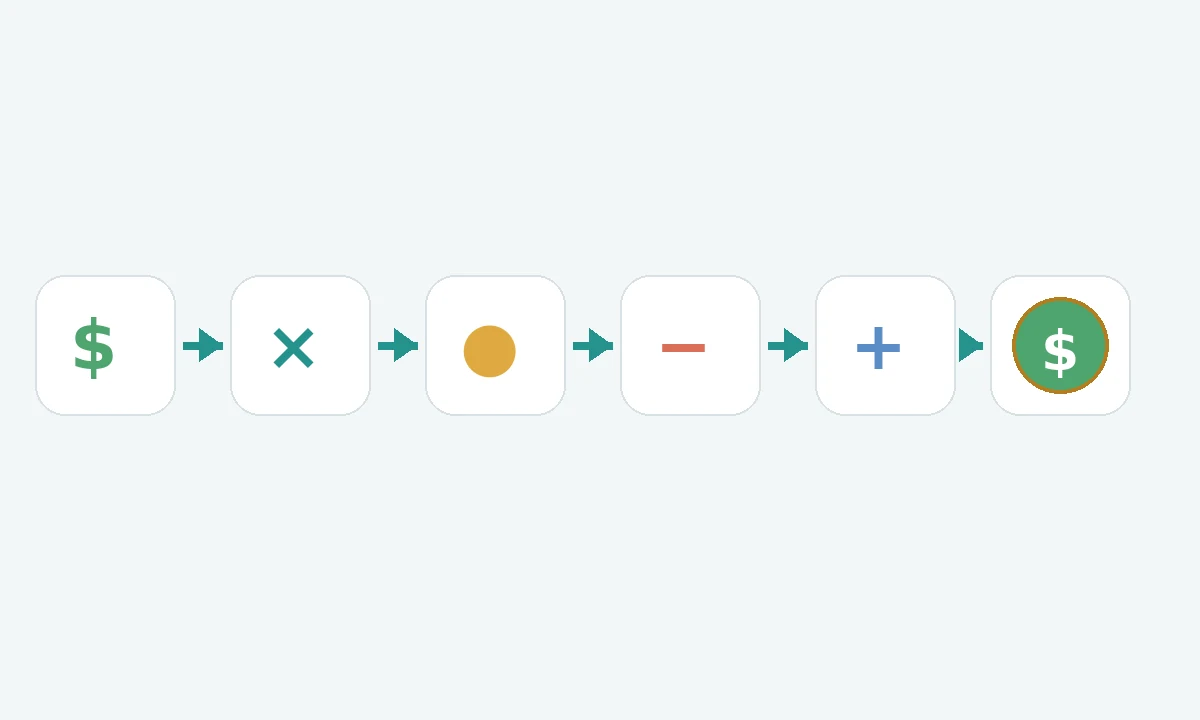
In simplified form, our logic looks more like this:
**Reward value
- relevant value of certain benefits − card costs = estimated annual value**
Even that formula requires judgement.
A no-fee card generating $500 could be more attractive than a $150 card generating $575.
On the other hand, paying an annual fee can make perfect sense when the card provides enough additional value.
Carte IQ therefore does not assume that free cards or fee-based cards are automatically superior.
We compare their net value.
5. We do not automatically give credits their full face value
Some cards include benefits such as:
- travel credits;
- annual credits;
- airport lounge access;
- insurance;
- free checked bags;
- hotel benefits;
- purchase protections.
These benefits can be worth a great deal — if you actually use them.
A $150 credit is not necessarily equivalent to $150 in cash for every cardholder.
If someone has to change their habits or make a purchase they otherwise would not have made just to use the credit, its true economic value may be lower.
Our principle is:
A benefit should not be treated as free money simply because it appears in a card’s marketing material.
When the value of a benefit depends heavily on the user, Carte IQ aims to treat it separately or explain the assumptions being used.
6. A welcome bonus is not the same as recurring value
Welcome offers can be extremely attractive.
But they create a problem when trying to identify which cards are genuinely best over time.
A card may offer a very large bonus in the first year while being much less appealing to keep afterward.
Carte IQ therefore aims to distinguish:
introductory value from recurring card value.
That lets us answer two different questions:
Is this card attractive to get right now?
and
Is this card attractive to keep for several years?
They are not always the same cards.
This distinction helps prevent rankings from being permanently dominated by whichever cards happen to have the biggest temporary welcome offers.
7. We also verify whether the card is actually available to you
A great card that you cannot obtain is not a great recommendation.
Carte IQ may therefore consider factors such as:
- geographic availability;
- known eligibility requirements;
- product-specific restrictions;
- whether the card is currently active;
- whether the offer is actually available.
We try not to assume that a card is accessible simply because it appears online.
For a service serving Canadian consumers, provincial availability can be particularly important.
8. We distinguish facts from assumptions
It is impossible to calculate the future value of a credit card perfectly.
Some inputs are objective:
- annual fees;
- earn rates;
- caps;
- eligible categories;
- offer terms.
Others require an estimate.
The future value of a loyalty point is a good example.
Carte IQ therefore aims to distinguish information taken from official card or loyalty-program terms from assumptions used by the engine to make comparisons.
When an estimate is necessary, we prefer to identify it as such rather than present the number as certain.
9. An unknown value is not automatically zero
This is an important Carte IQ principle.
When information is missing, the easiest approach would be to assign it a value of zero and continue the calculation.
That can create misleading results.
Unknown information does not necessarily mean a benefit does not exist or has no value.
Carte IQ therefore tries to identify material uncertainty.
In some cases, a card can still be evaluated despite a small uncertainty.
In others, a missing piece of information may be important enough to prevent a reliable comparison.
We would rather acknowledge that limitation than manufacture a highly precise ranking from incomplete data.
10. First place is not always an absolute truth
Imagine two cards whose estimated annual values are very close.
Card A: about $615 Card B: about $605
It would be tempting to state categorically that Card A is better.
But if reasonable point-value assumptions could move the result by $20 or $30, that conclusion is much less certain than it appears.
Carte IQ therefore aims to consider not only estimated value, but also how confident we can be in that estimate.
When two results are essentially tied, we would rather show that than create an artificial gap between first and second place.
11. “Best card” does not necessarily mean “apply for it today”
This distinction is fundamental.
A card may be theoretically excellent for your profile without meaning that you should necessarily make a new credit application today.
Your financial situation, credit history, recent applications and the cards you already hold may all matter.
Carte IQ is designed to optimize spending you already plan to make, not encourage you to:
- spend more to earn rewards;
- carry a balance and pay interest;
- accumulate cards unnecessarily;
- apply for credit simply to collect bonuses.
Interest paid on a carried balance can quickly exceed the value of rewards earned.
Paying balances responsibly matters far more than optimizing points.
12. Several cards can sometimes be better than one
There may be no single perfect card for every spending category.
One card may be exceptional for groceries.
Another may be better for travel.
A third may have no annual fee and provide strong coverage for everyday spending.
That is why Carte IQ is not interested only in the question:
What is the best card?
We also care about:
What reasonable combination of cards best covers a person’s spending?
However, every additional card should add real value.
Adding four cards to gain only a few extra dollars per year is not necessarily a good strategy.
The goal is intelligent optimization, not maximum complexity.
13. Affiliate commissions do not determine the ranking
Carte IQ may receive compensation when a user clicks certain links or applies through a partner financial institution.
That business model can help fund the service.
But there is an important rule:
The presence or amount of an affiliate commission must not change the ranking calculated by Carte IQ.
A card with no affiliate link can therefore rank ahead of a compensated card if the engine determines it is the better option.
We believe it is essential to separate:
the recommendation from the monetization of the website.
When a link is affiliated, that relationship should also be disclosed clearly.
A simplified example
Imagine two cards.
Card A
- annual fee: $150;
- strong grocery rewards;
- estimated reward value: $720;
- annual credit the user would genuinely use: $100.
Approximate value:
$720 + $100 − $150 = $670
Card B
- no annual fee;
- slightly lower reward rate;
- estimated reward value: $590.
Approximate value:
$590
Card A remains ahead in this example by roughly $80 per year.
But if the user never uses the $100 credit, the result becomes:
$720 − $150 = $570
Card B then becomes slightly better.
The best card therefore depends not only on its features, but also on how those features actually apply to the user.
Our goal: an explainable recommendation
Carte IQ is not meant to produce a mysterious number and ask users to trust it.
A good recommendation should be explainable.
We want users to understand:
- why a card scores well;
- which spending categories create that value;
- how much the fees cost;
- what point value was used;
- which benefits were counted;
- what assumptions were made;
- and what uncertainty could change the result.
In other words, the ranking is only the beginning.
Explaining the ranking is just as important as the ranking itself.
Carte IQ is not trying to find the card that earns the most points
We are trying to identify the card — or, when appropriate, the combination of cards — that creates the best balance among:
rewards, point value, fees, benefits, simplicity, eligibility and the user’s actual needs.
That may produce results that look less dramatic than advertising slogans.
But we believe they are more useful.
Because in the end, the best credit card is not the one with the biggest multiplier.
It is the one that creates the most value for you without encouraging you to spend more or take on unnecessary credit.
Frequently asked questions
Is the #1 ranked card automatically best for everyone?
No. The ranking depends on spending patterns, fees, how points are used and the value a user places on certain benefits.
Why doesn’t Carte IQ simply compare reward rates?
Because 5 points per dollar is not meaningful on its own without knowing the value of those points, applicable caps and card fees.
Are welcome bonuses included?
They can be analyzed, but Carte IQ aims to separate a one-time welcome offer from the card’s recurring value.
Can a card with an annual fee beat a no-fee card?
Yes. If additional rewards and benefits exceed the annual fee by enough, a fee-based card can create more net value.
Does Carte IQ earn commissions?
Some links may eventually generate a commission for Carte IQ. That relationship should be disclosed clearly and must not affect the ranking calculated by the engine.
Should I apply for the card ranked first?
Not necessarily. A card recommendation does not replace an assessment of your financial situation and credit profile. Keeping the cards you already have may also be preferable when the benefit of switching is small.
Key takeaway
Comparing credit cards requires much more than looking at the number of points shown in an advertisement.
Carte IQ aims to measure usable real-world value, taking into account spending, reward value, fees, caps, benefits, eligibility and uncertainty.
That is the logic behind our rankings.
Our principle: optimize what you already spend, not how much you spend.