Should you pay an annual fee for a credit card?
A $150 annual-fee card can be more profitable than a no-fee card — but only when its rewards and benefits genuinely exceed the cost.

In this guide
- The basic formula
- Compare with the best alternative, not with zero
- Break-even spending
- Annual credits are not always worth face value
- Airport lounges: real value or retail price?
- Insurance is even harder to value
- Fee-based cards may suit higher spenders
- Caps can change the break-even point
- Supplementary-card fees matter too
- What about foreign transaction fees?
- If you carry a balance, focus first on borrowing cost
- Reassess every year
- Carte IQ example
- Key takeaway
- How much do I need to spend to justify an annual-fee card?
- Does an annual credit automatically reduce the fee?
- Can insurance justify the annual fee?
- Are annual-fee cards bad for lower spenders?
- Should I close a fee-based card as soon as it stops being profitable?
- Sources consulted
- Related articles
- Compare based on your situation
“I will never pay for a credit card.”
That position is understandable.
Why pay $120, $150 or $200 per year when no-fee cards exist?
Because a fee-based card can sometimes generate enough additional rewards and benefits to be less expensive — or more profitable — than a free card.
But the opposite is equally true.
An underused premium card can become an unnecessary recurring expense.
The right question is not:
Does this card have a fee?
It is:
What do I get in addition for that fee?
The basic formula
The Financial Consumer Agency of Canada (FCAC) recommends comparing the value of rewards and benefits with the annual fee.
A simple version is:
Reward value + benefit value − annual fee = net value
Example:
- rewards: $500;
- benefits actually used: $100;
- annual fee: $150.
Net value:
$500 + $100 − $150 = $450
A no-fee card producing $350 would be less attractive in that scenario.
Compare with the best alternative, not with zero
Here is a common mistake.
A fee-based card earns $600 and costs $150. You conclude that it “earns $450.”
But if a no-fee card would have generated $400 on the same spending, the actual incremental benefit of choosing the fee card is:
$450 − $400 = $50
That marginal gain is what should determine whether the extra complexity and fee are worthwhile.
Carte IQ therefore needs to compare cards with alternatives, not only calculate them in isolation.
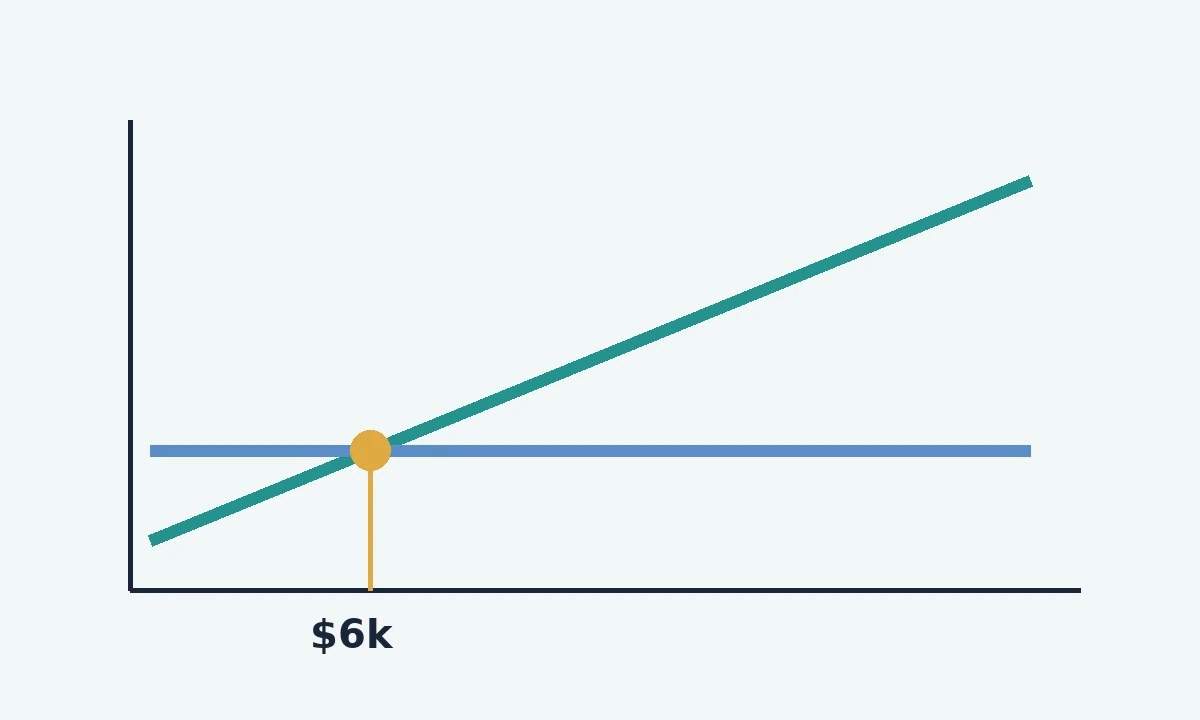
Break-even spending
Suppose:
No-fee card
2% return
Fee-based card
4% return Annual fee: $120
The fee card has a 2-percentage-point advantage.
To recover the $120:
$120 ÷ 2% = $6,000 of eligible spending
After $6,000, the fee card begins to pull ahead if all other conditions are equal.
This break-even calculation is extremely useful.
Annual credits are not always worth face value
A card costs $250 per year and includes a $200 credit.
Marketing may suggest:
“The card effectively costs only $50.”
Maybe.
If you would have spent that $200 in exactly the same way without the credit, the credit may be worth close to $200.
But if you need to book a service you normally never use, the personal value is lower.
Carte IQ should distinguish:
near-cash credit: replaces spending already planned;
conditional credit: requires a particular behaviour;
convenience benefit: useful but difficult to convert precisely into dollars.
Airport lounges: real value or retail price?
Suppose a card includes four lounge visits.
The combined retail price may be high.
But if you would never have paid for lounge access, assigning the full retail value to all four visits can inflate the card’s return.
Instead, ask:
- how many visits will you actually use?
- what would you reasonably have paid for each?
- does lounge access replace a meal expense or simply add comfort?
Carte IQ tries not to turn every benefit into “free money.”
Insurance is even harder to value
A card may include:
- travel insurance;
- trip interruption or cancellation;
- flight delay;
- car rental coverage;
- purchase protection;
- extended warranty.
These protections can be very useful.
But their value should not be calculated by simply adding the theoretical retail cost of every insurance policy as if the user would have purchased all of them separately.
A more prudent approach is to:
- confirm the coverage;
- identify what is actually relevant;
- show benefits qualitatively;
- assign a dollar value only when the assumption is defensible.
Fee-based cards may suit higher spenders
The more you spend in a bonus category, the more a small return advantage can be worth in dollars.
Example
Card A, no fee: 2% on groceries Card B, $150 fee: 4% on groceries
At $3,000 per year:
- A: $60;
- B: $120 − $150 = -$30.
The free card wins.
At $15,000:
- A: $300;
- B: $600 − $150 = $450.
The fee-based card wins.
There is no universal answer.
Caps can change the break-even point
The previous calculation assumes 4% applies to all grocery spending.
If the rate falls to 1% after $500 per month, the economics change.
Carte IQ must apply real caps and tiers or high-fee cards can look artificially attractive.
Supplementary-card fees matter too
A household may use additional cards for another family member.
Some issuers charge for supplementary cards.
If the analysis is for a household rather than one cardholder, those fees should be included when they are necessary to execute the strategy.
What about foreign transaction fees?
Annual fees are only one type of cost.
For a frequent traveller, foreign transaction fees may matter more than a $50 difference in annual fee.
A card should be evaluated according to the costs relevant to the user’s real behaviour.
If you carry a balance, focus first on borrowing cost
FCAC notes that interest rates can matter more than rewards if you regularly carry a balance.
A low-rate card with an annual fee may even cost less overall than a no-fee high-interest card for someone paying down debt.
In other words:
Rewards optimization comes after borrowing costs are under control.
Reassess every year
A fee-based card that was excellent last year may no longer be worth keeping.
Before renewal:
- review the rewards you actually earned;
- check which credits you actually used;
- count the benefits that mattered;
- subtract the fees;
- compare against a no-fee or lower-cost alternative.
That annual review is more reliable than keeping a card out of habit.
Carte IQ example
Card A — $0 fee
Reward value: $410 Benefits: $20
Net: $430
Card B — $150 fee
Reward value: $520 Credit genuinely used: $100 Other benefits valued: $40
Net: $510
Card B wins by $80.
That may be enough if the user also appreciates its benefits.
If the $100 credit goes unused, Card A wins by $20.
That is why the user profile matters.
Key takeaway
A free card is not automatically the cheapest card.
A fee-based card is not automatically premium value.
The right calculation includes:
- rewards;
- real value of benefits;
- annual and other fees;
- the best available alternative.
Pay an annual fee only when what you receive in return is worth more to you.
Frequently asked questionsHow much do I need to spend to justify an annual-fee card?
It depends on the return difference versus a no-fee alternative. The break-even point can be estimated by dividing the net fee by the incremental reward rate.
Does an annual credit automatically reduce the fee?
Only if you can actually use it. A $100 credit you do not use is worth $0 to you.
Can insurance justify the annual fee?
It can contribute to value, but you should confirm the coverage and avoid automatically assigning the full theoretical retail price.
Are annual-fee cards bad for lower spenders?
Not necessarily, but extra reward rates have less spending to apply to. Fixed benefits may still justify the card.
Should I close a fee-based card as soon as it stops being profitable?
Not necessarily. You may first check whether a product switch or another option is available and consider the credit-file consequences.
Sources consulted
- Financial Consumer Agency of Canada — Choosing a credit card.
- Financial Consumer Agency of Canada — How credit cards work.
- Financial Consumer Agency of Canada — Using your credit card responsibly.
Related articles
- Are credit-card welcome bonuses worth it?
- One credit card or several: which strategy works best?
- How Carte IQ ranks credit cards
Compare based on your situation
The examples in this article are general. Carte IQ aims to apply these principles to your spending, preferences and available cards to explain the estimated value behind each recommendation.