One credit card or several: which strategy creates more value?
One card is simple; several cards can cover spending better. Learn how to build an efficient wallet without adding unnecessary accounts.

In this guide
- Why one card can be the best strategy
- Why several cards can be better
- The concept of marginal value
- Simple example
- The fourth- or fifth-card trap
- Annual fees add up
- Benefits can overlap
- A backup card can be useful even if it earns less
- More cards should never mean more spending
- Multiple cards and your credit file
- What does a simple wallet look like?
- How Carte IQ can optimize a wallet
- Example of an ideal result
- A good strategy can be to change nothing
- Key takeaway
- How many credit cards should someone have?
- Do two cards double my rewards?
- Can a no-fee card be useful in a premium wallet?
- Should I apply for every recommended card at once?
- Can Carte IQ recommend that I do not change cards?
- Sources consulted
- Related articles
- Compare based on your situation
One card for everything.
It is simple, easy to track and sometimes completely sufficient.
But a card that excels at groceries may not be the best for travel. A travel card may be weak for everyday purchases. A premium card may also be poorly accepted in some places or too expensive to justify as a backup.
That is why several complementary cards can sometimes increase total value.
The real question is:
At what point does another card add enough value to justify the extra complexity?
Why one card can be the best strategy
Maximum optimization is not always the goal.
One card offers several advantages.
Simplicity
- one statement;
- one payment date;
- one rewards program;
- one set of rules;
- fewer accounts to monitor.
That simplicity reduces the risk of missing a payment or spending time managing small benefits.
Concentrated points
If all spending feeds one program, you reach a useful balance faster.
Two cards in different programs may earn more points in total but leave you with two smaller balances that are harder to use.
Easier budgeting
One card makes monthly spending easier to review.
For someone who values simplicity, accepting a slightly lower return can be an excellent decision.
Why several cards can be better
Cards have different strengths.
Suppose:
- Card A: excellent for groceries;
- Card B: excellent for travel;
- Card C: no fee and a good general return.
Using each card only where it creates real value can improve the total return.
This is the idea of category coverage.
The concept of marginal value
Carte IQ should not simply add the stand-alone value of multiple cards.
It should ask what each card adds to the existing wallet.
Suppose:
Card A alone
$600 of net value.
Card B alone
$500.
That does not mean:
A + B = $1,100.
The cards may reward the same spending.
If moving some spending from A to B produces only $150 of additional value, then B’s relevant value in the wallet is $150, not $500.
That is marginal value.
Simple example
Annual spending:
- groceries: $12,000;
- restaurants: $6,000;
- other: $18,000.
Card A
- 4% groceries;
- 1% elsewhere;
- fee: $0.
Value:
groceries: $480 rest: $240
Total: $720
Card B
- 4% restaurants;
- 2% other;
- 1% groceries;
- fee: $120.
If B completely replaced A:
groceries: $120 restaurants: $240 other: $360 less fee: $120
Net: $600
Card A alone is better.
But together:
- A for groceries: $480;
- B for restaurants: $240;
- B for other: $360;
- B annual fee: -$120.
Total: $960
The pair adds $240 compared with Card A alone.
The second card therefore has a clear role.
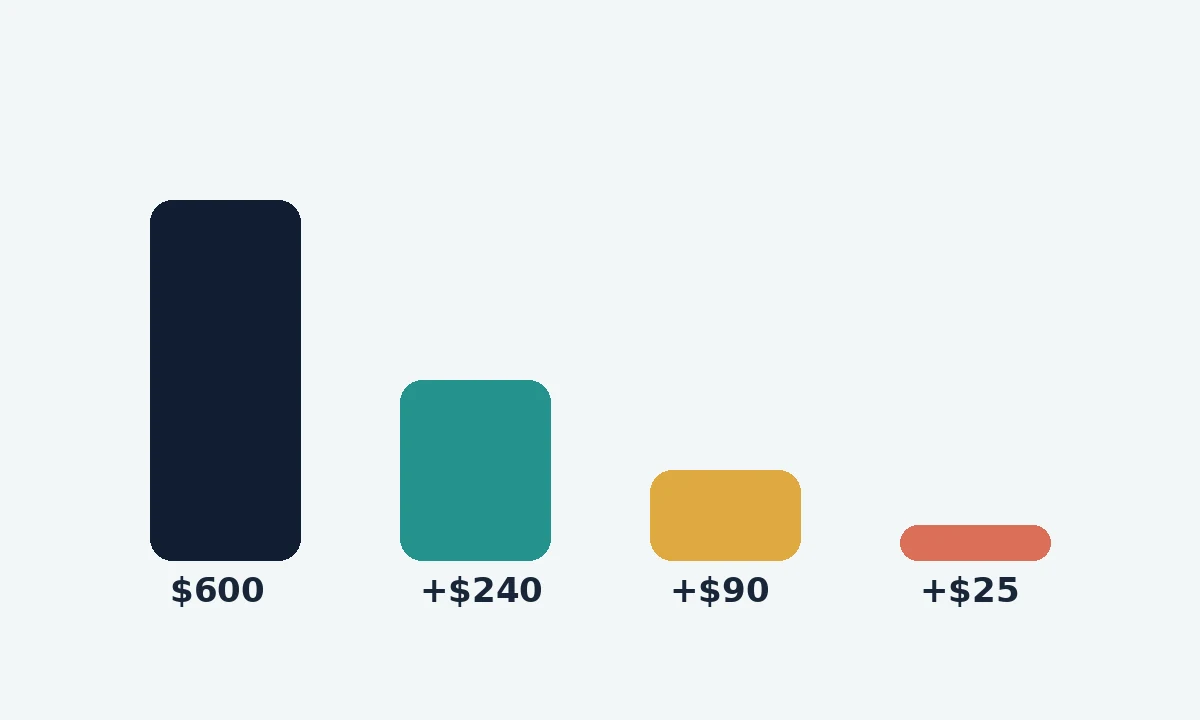
The fourth- or fifth-card trap
Marginal gains often decline.
The first cards cover the largest categories.
Later cards may optimize only a small slice of spending.
Example:
- 1st card: $600;
- 2nd card: +$240;
- 3rd card: +$90;
- 4th card: +$25.
The fourth card may objectively be “best” in a narrow category, but $25 per year may not justify:
- a new account;
- another application;
- another payment date;
- another app;
- the risk of forgetting a benefit or fee.
Carte IQ should be able to apply a complexity penalty or at least make the marginal gain explicit.
Annual fees add up
Two $150 cards cost $300 per year.
Three premium cards can easily total several hundred dollars in fixed fees.
For a wallet to be efficient, every fee-based card needs to earn its place.
A useful question is:
If I remove this card, how much value do I lose?
If the answer is only $40 and the card costs $150, the wallet can probably be simplified.
Benefits can overlap
Two cards may both offer:
- lounge access;
- travel insurance;
- travel credits;
- hotel status;
- similar purchase protections.
Adding the full value of every benefit would double count.
You do not necessarily need two nearly identical insurance packages.
A portfolio must account for overlapping benefits as well as overlapping reward categories.
A backup card can be useful even if it earns less
Value is not only about the reward rate.
A second card on a different payment network can be useful if:
- one network is not accepted;
- a card is blocked;
- an account is compromised;
- you are travelling and need an alternative.
That resilience has practical value that is difficult to express precisely in dollars.
A no-fee card can be especially useful as a backup.
More cards should never mean more spending
A behavioural mistake is:
“This card earns 5× at restaurants, so I can eat out more.”
No.
A reward does not turn an unnecessary purchase into savings.
FCAC emphasizes that a credit card does not increase the amount of money you have and that spending should remain within your normal household budget.
Carte IQ therefore optimizes how existing spending is allocated, never how much you spend.
Multiple cards and your credit file
Holding multiple accounts is not automatically bad.
But obtaining several new cards generally requires several credit applications.
FCAC recommends limiting the frequency of applications and avoiding too many in a short period.
A portfolio that is optimal on paper is not necessarily one you should build this week.
An acquisition order may be more prudent.
What does a simple wallet look like?
There is no universal composition, but a conceptual model might include:
Core card
Good overall value, easy to keep, useful rewards program.
Specialist card
Excellent in a major category where the core card is weaker.
Backup card
Often no-fee, potentially on another network, kept for resilience and possibly account age.
This does not mean everyone needs three cards.
It simply illustrates that every additional card should have a clear role.
How Carte IQ can optimize a wallet
A portfolio engine should not ask:
What are the three highest-ranked cards?
It should solve:
What combination of cards maximizes the value of my spending while accounting for fees, overlap and the cards I already own?
Then it can add constraints such as:
- maximum number of cards;
- fee tolerance;
- preferred programs;
- desired simplicity;
- cards already held;
- important categories;
- minimum marginal value.
The engine can then show:
- best single card;
- best two-card combination;
- best three-card combination;
- incremental gain at each step.
Example of an ideal result
Best single card: $640/year
Add Card B: +$210/year
Add Card C: +$45/year
Carte IQ could then explain:
The two-card setup captures most of the available gain. The third card adds only $45 and increases complexity, so it is optional.
That is more useful than a list of ten “recommended” cards.
A good strategy can be to change nothing
If your current cards already cover your spending well, the engine should be able to conclude:
No new card adds enough value to justify a change.
That is an important result.
A comparison site that earns affiliate commissions could be tempted to always encourage a new application.
Carte IQ should do the opposite when the numbers say so.
Key takeaway
One card can be excellent if you value simplicity.
Several cards can create more value when they:
- cover different categories;
- avoid unnecessary fees;
- have limited overlap;
- remain easy to manage;
- do not encourage more spending.
The right wallet is not the one with the most cards.
It is the one where every card has a clear reason to be there.
Frequently asked questionsHow many credit cards should someone have?
There is no ideal number for everyone. Management capacity, fees, marginal value and your needs determine the right number.
Do two cards double my rewards?
No. The same spending generally goes on only one card. You need to calculate the best use of each card.
Can a no-fee card be useful in a premium wallet?
Yes. It can serve as a backup, preserve an older account or cover a category without adding fixed fees.
Should I apply for every recommended card at once?
No. An acquisition sequence is usually more prudent than several simultaneous applications.
Can Carte IQ recommend that I do not change cards?
Yes. Ranking independence requires “do nothing” to remain a valid outcome when marginal value is too small.
Sources consulted
- Financial Consumer Agency of Canada — Choosing a credit card.
- Financial Consumer Agency of Canada — Improving your credit score.
- Financial Consumer Agency of Canada — Using your credit card responsibly.
Related articles
- Should you switch credit cards often or keep the same ones?
- Is a 5× card really better than a 3× card?
- How Carte IQ ranks credit cards
Compare based on your situation
The examples in this article are general. Carte IQ aims to apply these principles to your spending, preferences and available cards to explain the estimated value behind each recommendation.