Is a 5× points card really better than a 3× card?
5× is not automatically better than 3×. Learn how point value, caps, annual fees and spending categories change a card’s real return.

In this guide
- The fundamental formula
- Even a 1× rate can be excellent
- The advertised rate may not apply everywhere
- Example with a cap
- Merchant categories matter
- Annual fees can reverse the ranking
- Credits can also change the result
- Point value can depend on how you redeem
- Welcome bonus: be careful with first-year rankings
- Your highest bonus category may not be your biggest category
- A more complete formula
- Full example
- Why Carte IQ explains the result
- Key takeaway
- Does 5 points per dollar mean 5%?
- Is a 10× card automatically exceptional?
- How does Carte IQ choose a point value?
- Are annual fees always subtracted?
- Why did my purchase not receive the multiplier I expected?
- Sources consulted
- Related articles
- Compare based on your situation
Five is larger than three.
So a card earning 5 points per dollar should beat a card earning 3 points per dollar.
Mathematically, that sounds obvious.
Financially, it is incomplete.
The number of points earned is only half of the equation.
The other half is the value of each point.
The fundamental formula
To convert a multiplier into an approximate return:
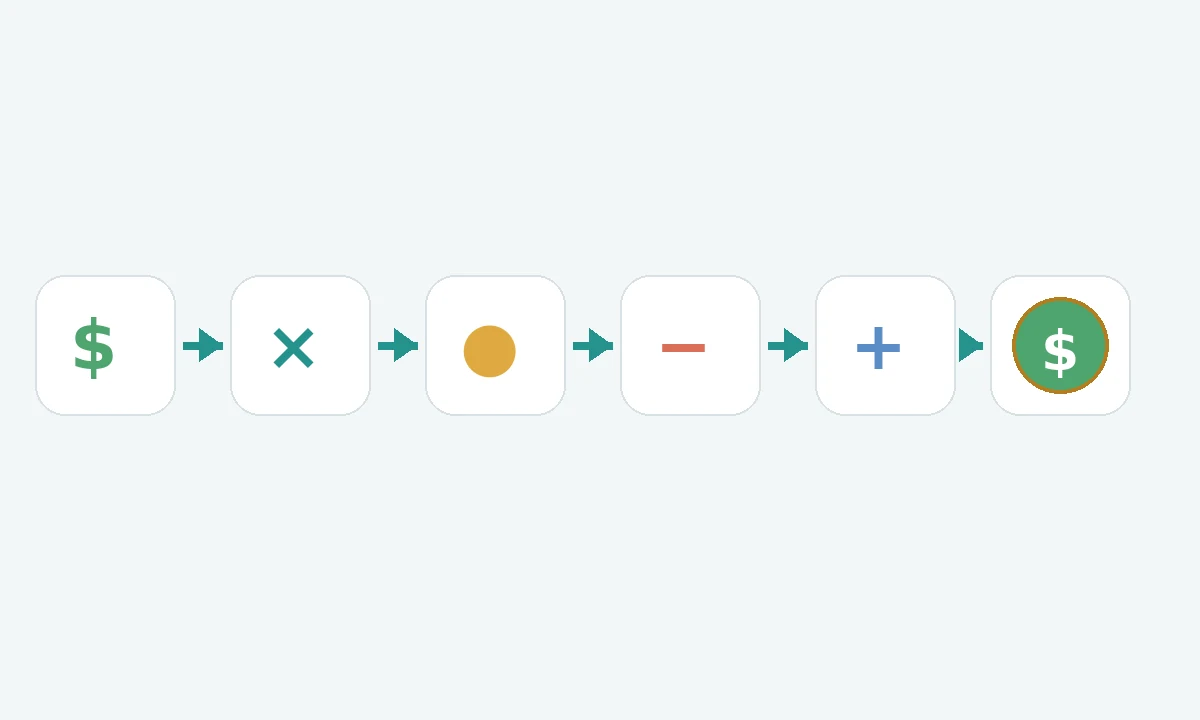
multiplier × point value = return
Card A
5 points per dollar Point value: 0.7 cent
5 × 0.7¢ = 3.5¢ per dollar
Approximate return: 3.5%
Card B
3 points per dollar Point value: 1.5 cents
3 × 1.5¢ = 4.5¢ per dollar
Approximate return: 4.5%
The 3× card wins.
That is why Carte IQ never ranks a card based only on its multiplier.
Even a 1× rate can be excellent
Suppose points in a program are regularly worth 2 cents in the type of redemption you use.
At 1 point per dollar:
1 × 2¢ = 2%
That already beats a card earning 3× in a program whose points are worth only 0.5 cent:
3 × 0.5¢ = 1.5%
The word “point” says very little about economic value on its own.
The advertised rate may not apply everywhere
A card can advertise “5×” prominently while limiting that rate to:
- groceries;
- restaurants;
- certain merchants;
- a maximum monthly spend;
- a maximum annual spend.
Spending above the cap may revert to the base rate.
The right question is therefore not:
How much does this card earn?
but:
How much does this card earn on my actual spending?
Example with a cap
Imagine a card that earns:
- 5× on the first $2,500 per month in a category;
- 1× afterward.
You spend $3,500 per month in that category.
The calculation is not:
$3,500 × 5.
You need to separate:
$2,500 × 5 + $1,000 × 1
The true average multiplier is therefore below 5×.
The further your spending exceeds category caps, the more important that difference becomes.
Merchant categories matter
You may think of a purchase as groceries.
The payment network may code the merchant differently.
Bonus rates are generally applied according to merchant classification and issuer terms, not your personal description of the purchase.
That is why two purchases that look similar can sometimes earn differently.
Carte IQ should avoid promising that a specific merchant will always code in a given category unless reliable confirmation exists.
Annual fees can reverse the ranking
Suppose we compare two cards.
5× card
Gross annual value: $650 Annual fee: $180
Net value: $470
3× card
Gross annual value: $560 Annual fee: $0
Net value: $560
The card that earns fewer points produces more net value.
Fees do not make a card bad.
They simply need to be justified by real incremental value.
Credits can also change the result
A card costs $200 but includes a $150 travel credit.
Should its net cost be treated as $50?
Only if you actually use the credit for spending you would have made anyway.
If the credit causes you to spend $150 you otherwise would not have spent, its economic value is different.
Carte IQ therefore needs to be careful with credits so that card value is not artificially inflated.
Point value can depend on how you redeem
Scene+ currently offers several redemptions at one cent per point, making some calculations relatively direct.
Aeroplan, by contrast, uses more variable pricing for Air Canada and selected partners, while many other partner rewards are structured around distance and zones.
An Aeroplan multiplier therefore needs to be combined with a point-value assumption.
The same idea applies to flexible programs such as Membership Rewards, where several redemption methods exist.
Welcome bonus: be careful with first-year rankings
A card can look extraordinarily profitable in the first year because of a welcome offer.
But the 5× multiplier is not the welcome bonus.
A fair comparison should show separately:
first-year value
and
recurring value.
Otherwise, an average card with a temporary offer can look permanently better than a strong long-term card.
Your highest bonus category may not be your biggest category
A 5× grocery card is not very useful if you spend only $150 per month on groceries.
A 3× travel card may matter much more if you spend $10,000 per year on travel.
The weight of each category in your budget matters just as much as the multiplier.
Carte IQ therefore aims to calculate an annual value weighted by real spending.
A more complete formula
A simplified version can look like this:
**Sum of spending in each category × applicable multiplier × point value − annual fees
- benefits actually valued**
Even that formula must consider:
- caps;
- tiers;
- exclusions;
- terms;
- uncertainty.
That is why a serious comparison cannot be reduced to one marketing number.
Full example
Profile
- groceries: $12,000/year;
- other purchases: $18,000/year.
Card A
- 5× groceries;
- 1× other purchases;
- point value = 0.8¢;
- fee = $150.
Points earned:
12,000 × 5 = 60,000 18,000 × 1 = 18,000 Total = 78,000 points
Value:
78,000 × $0.008 = $624
Net value:
$624 − $150 = $474
Card B
- 3× groceries;
- 2× other purchases;
- point value = 1¢;
- fee = $100.
Points earned:
12,000 × 3 = 36,000 18,000 × 2 = 36,000 Total = 72,000 points
Value:
72,000 × $0.01 = $720
Net value:
$720 − $100 = $620
The 3× card wins by a wide margin.
Why? Better point value, stronger non-category earning and lower fees.
Why Carte IQ explains the result
A useful ranking should be able to say:
This card ranks first because your non-grocery spending is substantial, and the point value used in the calculation offsets its lower grocery multiplier.
That is more useful than:
Score: 92/100.
The number is not the recommendation.
The reasoning behind the number is the recommendation.
Key takeaway
A multiplier is not a return.
To understand what a card actually earns, you need to know:
- point value;
- categories;
- caps;
- fees;
- credits;
- your spending;
- how you redeem.
5× can beat 3×. But 3× can also beat 5× — sometimes by a lot.
Frequently asked questionsDoes 5 points per dollar mean 5%?
Only if each point is worth one cent for the redemption being used.
Is a 10× card automatically exceptional?
No. You still need the point value, category, cap and duration of the rate.
How does Carte IQ choose a point value?
Using program data and explicit, revisable valuation assumptions. When value varies significantly, a range may be more appropriate.
Are annual fees always subtracted?
They should be reflected in net value. Some credits or benefits can offset part of the fee when they create real value for the user.
Why did my purchase not receive the multiplier I expected?
Merchant coding, exclusions, caps or terms may explain the difference.
Sources consulted
- Financial Consumer Agency of Canada — Choosing a credit card.
- American Express Canada — Membership Rewards Program Terms and Conditions.
- Scene+ — Earning and redeeming points.
- Air Canada — Aeroplan and flight rewards.
Related articles
- How much is a reward point really worth?
- Points or cash back: how should you choose?
- How Carte IQ ranks credit cards
Compare based on your situation
The examples in this article are general. Carte IQ aims to apply these principles to your spending, preferences and available cards to explain the estimated value behind each recommendation.